






Back to Blog Index
Barcode Verification vs. Barcode Scanning: Why They’re Not the Same
In the world of product labeling, packaging, and logistics, barcodes are essential for tracking and identifying items efficiently. Yet many businesses confuse barcode scanning with barcode verification—two very different processes that serve very different purposes. Understanding the distinction is crucial for ensuring reliable data capture, compliance with industry standards, and avoiding costly chargebacks or reprints.
What Is Barcode Verification?
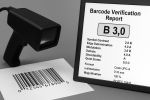
Barcode verification is the process of grading the print quality and compliance of a barcode according to established industry standards such as ISO/IEC 15416 (for linear barcodes like Code 128 and UPC) or ISO/IEC 15415 (for 2D codes like Data Matrix and QR).
A barcode verifier is a precision instrument that measures:
- Symbol contrast: The difference in reflectance between light and dark bars.
- Edge determination: How sharply the bars and spaces are defined.
- Modulation: The uniformity of the barcode’s reflectance.
- Defects: Imperfections such as voids or spots.
- Decodability: The accuracy of the encoded pattern.
- Quiet zones: Whether there’s enough clear space around the code.
Each parameter is scored, and the barcode is assigned a grade from A (4.0) to F (0.0). A passing grade (usually C or higher) indicates that the barcode is likely to scan reliably across a range of readers and lighting conditions.
Barcode verification doesn’t just check that a code can be read—it ensures that any compliant scanner in any environment can read it consistently. This makes it especially important for suppliers in industries such as:
- Retail (UPC/EAN compliance)
- Medical devices and pharmaceuticals (UDI labeling)
- Aerospace and defense (MIL-STD-130, UID)
- Logistics and warehousing (GS1, Code 128)
- Automotive (AIAG B-10)
What Is Barcode Scanning?
Barcode scanning simply means reading the data encoded in a barcode using a handheld or fixed scanner. It answers one question only:
“Can this barcode be read right now by this scanner?”
A barcode might scan successfully in your facility but fail elsewhere due to differences in lighting, printer quality, substrate reflectivity, or scanner sensitivity. Scanning doesn’t measure symbol quality—it just confirms legibility at that moment.
While scanning is an important operational step, it’s not a diagnostic tool. A barcode that passes a scan test can still fail verification if it doesn’t meet ISO or GS1 standards.
Key Differences
| Feature | Barcode Verification | Barcode Scanning |
|---|---|---|
| Purpose | Measures quality and compliance | Reads data |
| Equipment | Barcode verifier (ISO-calibrated) | Barcode scanner |
| Output | Grade (A–F) and detailed report | Decoded data only |
| Standards Used | ISO/IEC 15415 / 15416 / GS1 / MIL-STD-130 | None |
| Use Case | Quality control, compliance, supplier audits | Day-to-day operations |
| Result | Determines long-term readability | Confirms immediate readability |
Why Verification Matters
Barcode verification ensures your labels meet industry requirements before they reach your customer’s warehouse or production line. Poor print contrast, damaged substrates, or incorrect bar widths can all cause scanning failures downstream. Failed barcodes can lead to:
- Shipment rejections
- Chargebacks from retailers or distributors
- Delayed inventory processing
- Damaged supplier reputation
By verifying at the point of print, you can identify and correct issues early—before they become expensive problems.
Conclusion
In short, scanning tells you if a barcode works, while verification tells you if it’s good enough to work everywhere. Any company that prints barcodes for external use—especially in regulated industries—should integrate verification into their quality assurance process. It’s the difference between a barcode that works today and one that always works.
WePrintBarcodes.com offers complete verification services for both 1D and 2D barcodes. You can read more about our service here


